Under-roof shading · made to measure Cut to your
centimetres.
Blackout honeycomb that runs under your glass, between the rafters.
Four steps, one week
A glass roof is a greenhouse you have to live under
It gets too hot to sit in
Sun through glass warms the air under it faster than it can escape. By mid-afternoon the veranda is the one room nobody uses.
You cannot see a screen
Glare off a laptop or a television under a glass roof makes the space useless for anything but squinting.
Shading above the glass is a project
Roof-mounted fabric means scaffolding, fixings into the structure and a system out in every storm. This goes under the glass, fixes to the rafters, and arrives as a flat box.
The same sun, stopped in two very different ways
Almost every veranda quote is for shading laid over the roof. It is the older answer and it is not a bad one, but it is a building job with a building job’s price. This goes under the glass instead, and that one decision changes everything below.
| Under the glass | Over the glass | |
|---|---|---|
| What it costs | From €460 a section, on the screen before you order. Delivery is worked out from your postcode at checkout and nothing is added afterwards. | Quoted after a survey, with the system, the structural fixings and a crew’s day all inside one figure you see at the end. |
| Who puts it up | Two people, a cordless drill and an afternoon. The guides screw to the rafters and the drive is already in the tube. | A fitting crew, usually with scaffolding or a platform, because all of the work happens above the glass. |
| Keeping it clean | It lives indoors. It gets dusted when the room does, and that is the whole of the maintenance. | It is outdoors, so it collects what outdoors brings — pollen, leaves, bird mess, green growth — and cleaning it means going up on the roof. |
| Weather | Nothing reaches it. No wind class to respect, nothing to bring in before a storm, nothing to check after hail. | Wind, rain, hail and frost all reach it, and most systems have to be retracted above a stated wind speed — which is the speed at which you wanted the shade. |
| Light when it is open | Retracted, it folds back along the rafter and the glass is clear again. The veranda gets back every bit of the daylight it was built for. | The cassette, the rails and the folded fabric stay over the glass all year, so something is always between the room and the sky. |
| How long it lasts | The fabric never sees rain, wind or unfiltered UV, so it ages like an indoor blind. Five years on the motor, three on the fabric. | Outdoor fabric is built for weather, but it is still a fabric left out in it every day of the year. |
| Running it | A 12 V drive already in the tube, off a rechargeable wand. No cable across the roof, no electrician, and Matter through the hub if you want your phone to close it. | Mains power taken up to the roof, which usually means an electrician and a cable route somebody has to hide. |
Where over-roof shading wins
Shading outside the glass stops the sun before it reaches the glass, so the structure itself stays cooler — that is simple physics and no table can argue with it. Under-roof shading takes the glare and the hot spot out of the room while the glass above it still warms. For most verandas that is the part people actually live with. For an uninsulated glass roof facing full south all day, it is worth telling us so before you order.
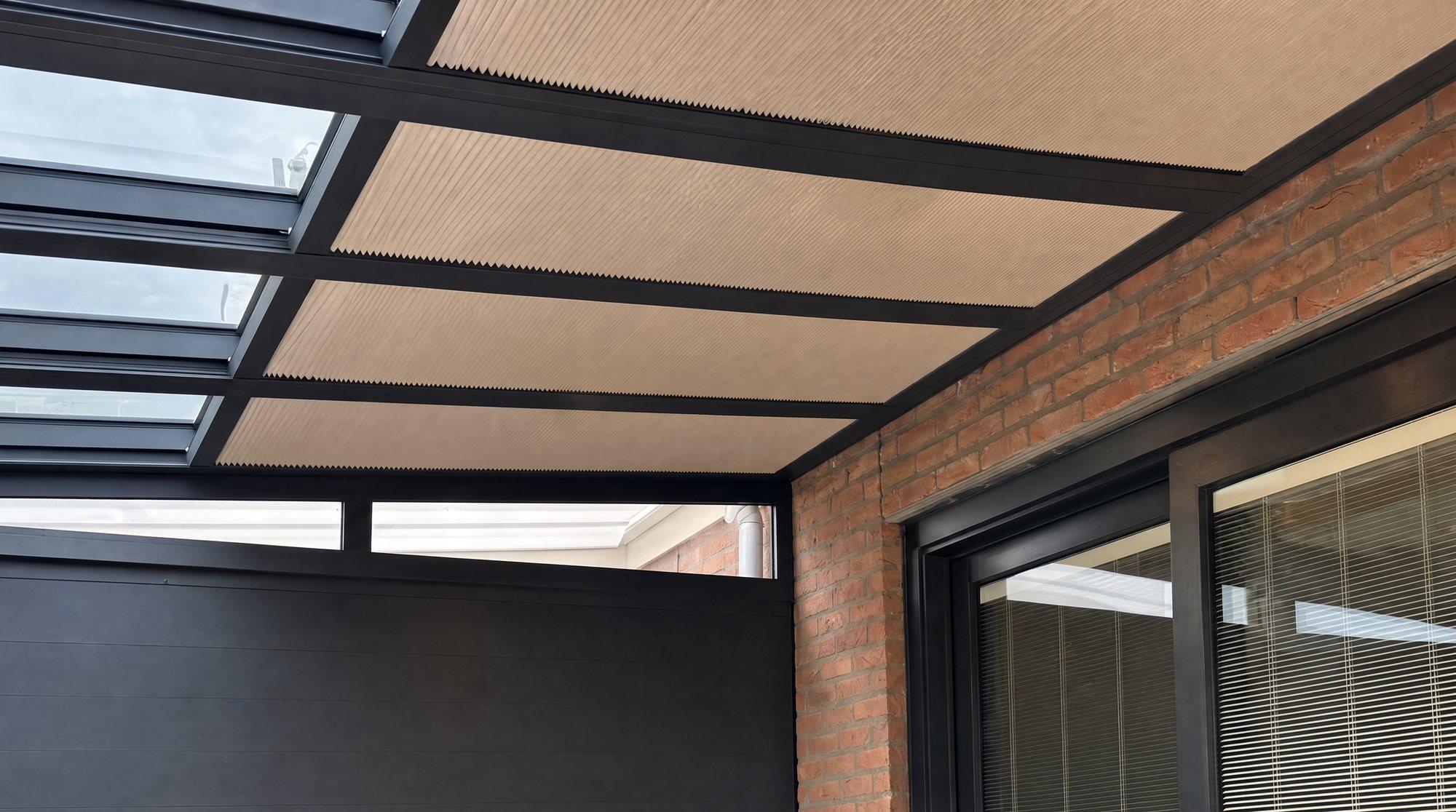
Two people, a drill, an afternoon
The guides screw to the rafters, the track drops into the guides and the drive is already in the tube. There is nothing to cut and nothing to wire.
What arrives
Tracks cut to your opening, aluminium guides, the drive already fitted in the tube, the remote, all fixings, and a printed drawing with your own measurements on it.
What you need
A cordless drill, a spirit level, a stepladder and someone to hold the other end. The drive runs at 12 V off a battery wand, so no electrician and no cable across the roof.
If you would rather not
Add fitting in the configurator and our team comes to you. The price is on the screen before you order, not after a visit.
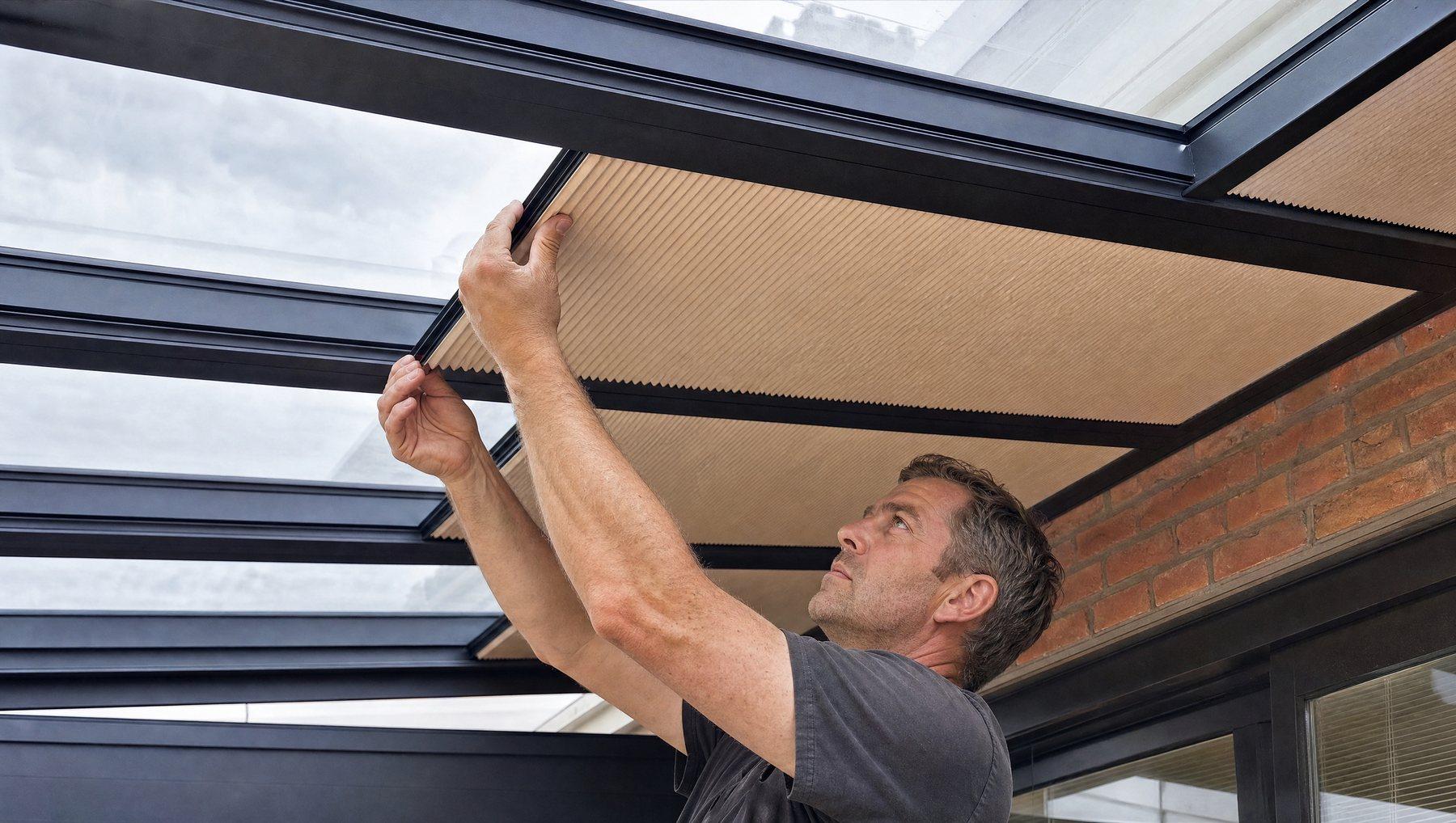
Every cell holds a pocket of still air
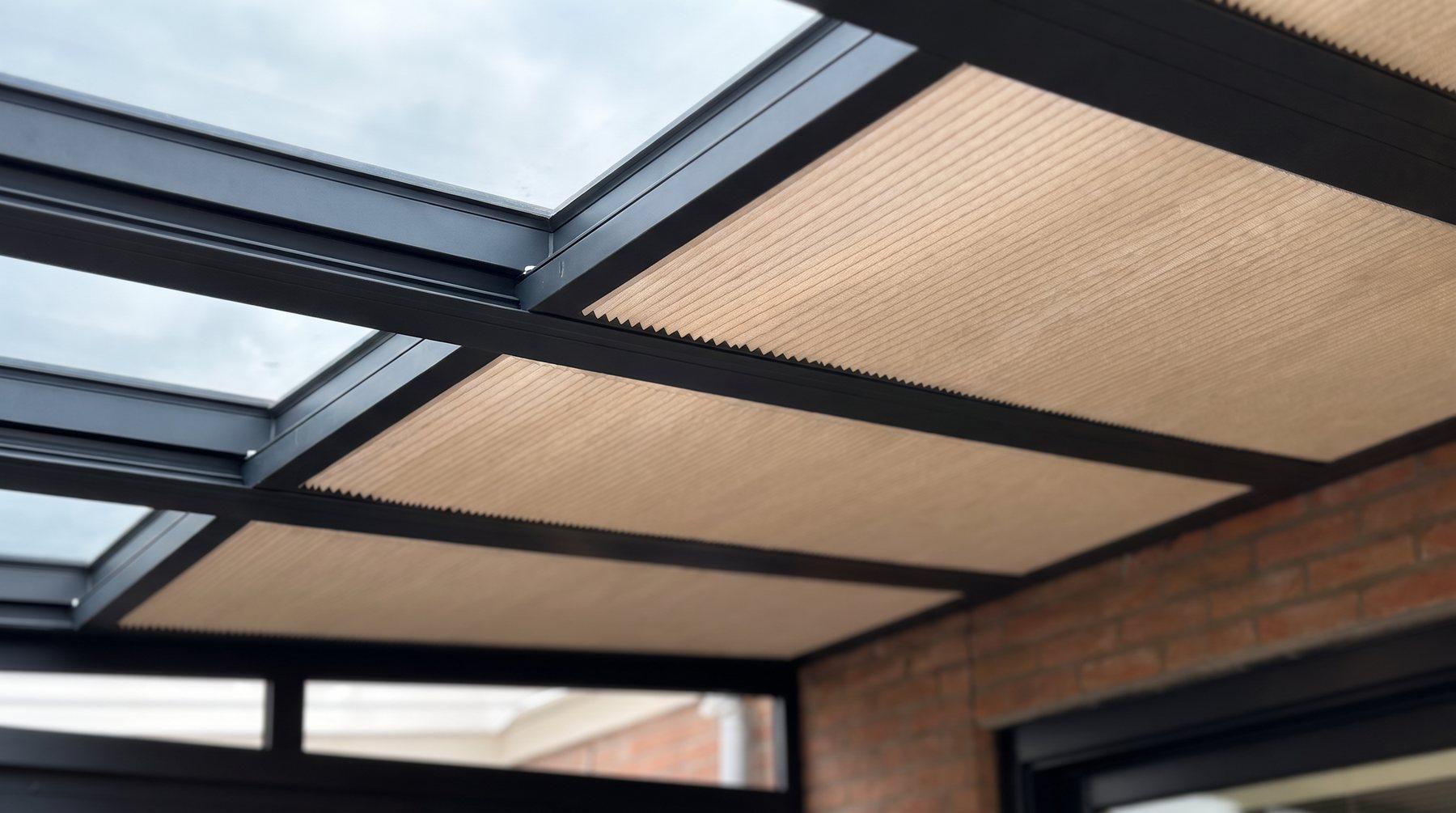
Air does the insulating
A 25 mm honeycomb traps a layer of still air between the glass and the room — the same thing that makes double glazing work. Nothing mechanical, nothing to maintain.
Blackout, not dimming
The Ivrea BO fabric is a true blackout, so the veranda goes from glare to shade rather than from bright to slightly less bright.
Tight to the rafters
The guides fix to the rafters, not the glass, and the fabric runs the full bay. No gap at the edge for a hot stripe to come through.
Everything, in writing
Fabric
- Barida Ivrea BO honeycomb
- 25 mm, blackout
- 100% PES, non-woven, laminated
- EN 410:2011
- EN 14501:2021
- EN 13363-1
- ISO 105-B02, class 6
- OEKO-TEX® Standard 100
- Lead, phthalates, PVC, formaldehyde
Drive
- Barida BRQ24WF/S silent tubular
- 24 mm
- DC 12 V
- 0.8 N·m
- 28 / 34 / 40 rpm, adjustable
- ≤ 36 dB
- RF 433 MHz remote, 15 channels
- Matter via ME-Box hub
- 6 min continuous
- 6.0 m
Fabric colours
- White
- Beige
- Sand
- Mouse grey
- Charcoal
- Black
Profile finishes
- Cream white
- Anthracite
- Jet black
A remote in the box. Your phone, if you want it.
Every motorised track ships with a 15-channel remote. Add the ME-Box hub and the system speaks Matter — so Apple Home, Google Home, Alexa, SmartThings and Home Assistant all see it, and the shading can close itself when the sun comes round.
The drive runs at 12 volts and no louder than 36 dB. A charged battery wand lasts a season; add the solar panel and it charges itself.
- Apple Home
- Google Home
- Amazon Alexa
- SmartThings
- Home Assistant
- Matter
- 5 years
- 3 years
- 2–3 days
- BE · NL · LU · DE
Three numbers decide it
This suits a roof with rafters and a clear run between them, which is nearly every veranda and conservatory built in the last thirty years. If yours has that, these are the only limits there are.
- 4 cm
Clearance under the glass
The guides and the folded fabric need that much free space between the underside of the glass and the bottom of the rafter. Measure it before anything else — it is the one figure that can rule the whole thing out.
- 120 cm
Widest one section
Measured between the rafters, not across the glass. A wider roof is not a problem; it simply has more sections, and each is cut to its own opening.
- 600 cm
Longest one section
Front to back, down the fall of the roof. Up to 12 sections in a single order, which covers a very large veranda.
- A veranda that is out of square is fine. Every section is measured and cut on its own, so the bays never have to match each other.
- Steel rafters, or a roof over a stairwell, are the two cases where we would rather come and fit it than have you up a ladder.
- One unbroken sheet of glass with no rafters is the one roof this does not suit — there is nothing for the guides to fix to.
The questions we always get
How do I measure it?
Between the rafters, not the glass. Start with the clearance: the system needs at least 4 cm of free space under the glass. Then, for each section, the width from the inside of one beam to the inside of the next, and the depth from the front to the back. Measure both ends and send the smaller number. The configurator asks for every section separately because they are rarely identical, and it walks you through it.
What if I measure it wrong?
Made-to-measure means your tracks only fit your opening, so a wrong measurement is the one real risk of buying this online. Two things help: order a free sample card and the measuring guide first, or add fitting — our team measures on the day and the fit is then our responsibility, not yours.
Can I return it?
Goods made to your measurements are excluded from the 14-day right of withdrawal under EU consumer law, because they fit nobody else's veranda. What you do get: if what arrives does not match the measurements on your order, or anything is damaged in transit, we remake it at our cost and collect the original.
Can I really fit it myself?
Most people do. The guides screw to the rafters, the track drops in, and the drive is already in the tube — nothing to cut, nothing to wire, and the drive runs on a battery wand at 12 V. Two people and an afternoon is the normal case. If your rafters are steel, or the roof is above a stairwell, add fitting instead.
Will it fit my veranda?
If your roof has rafters and a clear run between them, yes. Each section is made up to 1.2 m wide and 6 m long, and the guides fix to the rafters rather than the glass. A wider roof simply has more sections — and because they are each measured on their own, a veranda that is out of square is not a problem.
How fast is it really?
Two to three working days in the workshop, then a named delivery day. We confirm the production date in writing when payment clears, and the drawing goes out with it.
Can I use it with my phone?
The remote is included. Add the ME-Box hub and the system speaks Matter, which means Apple Home, Google Home, Alexa, SmartThings and Home Assistant all see it. One hub drives up to 30 motors and 40 scenes.
Place your
order
Tell us where it goes and we start cutting. You get a payment link by email within the hour, and the tracks leave the workshop two to three working days after it clears.
- Delivery across Belgium, the Netherlands, Luxembourg and Germany
- Made to your exact measurements
- 5-year motor warranty, 3-year fabric
Nothing configured yet — measure your sections first and the price comes with it.
Configure it